
Shopping Cart
EU car seat test: 7 out of 9 child seats fail the crash test
11/01/2026 22:15:24 , Child development
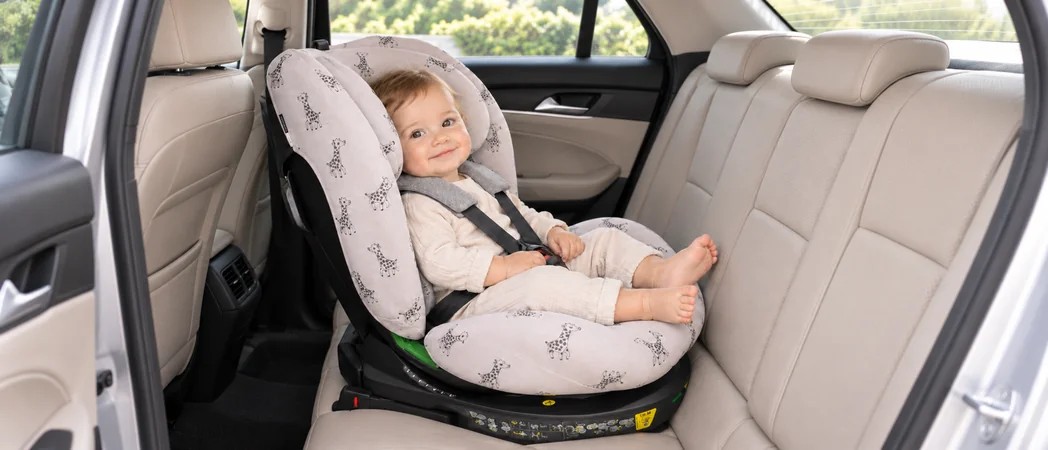
In April 2026 the European Commission published the results of an unusual control campaign: market surveillance authorities in eight countries randomly bought 9 child car seats sold in shops and put them through the tests of the European standard R129 (i-Size). The result is worrying for any family: 7 of the 9 seats failed the crash tests and only one passed every test.
There is no need to panic, but it is a good reason to check the seat in your car. In this article we explain what was found and give you a practical checklist you can go through in five minutes.
What was tested and which failures appeared
The study is part of the European project JACOP 2024. The seats, from seven different brands, were bought in Latvia, Estonia, Poland, Croatia, Malta, Ireland, Finland and the Netherlands. In total, 12 restraint systems were tested: the 9 seats and the bases of three of them.
- Crash tests: frontal impact at 50 km/h, rear impact at 30 km/h and side impact at 24 km/h. 7 of the 9 seats failed, with broken headrests and insufficient protection of the child's head, neck and chest.
- Documentation and labelling checks: 6 of the 9 seats failed because of incomplete warnings or instructions, an incorrectly declared height range or corrosion. The bases of three seats also failed.
- Risk level: 6 seats were classified as serious risk, 1 as high risk and 2 as medium risk. Two were recalled from consumers.
The Commission has not published the brands or models concerned: it says the assessments to decide on measures are still ongoing. That is why the most useful thing you can do today is check the seat you use yourself.
Checklist: check your car seat in 5 minutes
These points come from the recommendations accompanying the European study and from the requirements of the R129 standard.
1. Look for the approval label
Every approved seat carries a label stating the standard it meets. If you cannot find it, if it is unreadable or if the warnings and instructions are missing, that is a red flag. Missing markings were one of the most frequent failures in the study.
2. Check whether it is R129 or R44
Since 1 September 2024, seats approved only under the old R44 standard can no longer be sold in the EU. R129 classifies seats by the child's height in centimetres (not by weight groups) and includes a mandatory side-impact test, which R44 did not require. Whether you buy a new or second-hand seat, make sure it is R129.
3. Check the height range and do not push it
The R129 label shows the minimum and maximum height of the child. When your child reaches the height or weight limit, it is time to change seats, or to switch from rear-facing to forward-facing if the model allows it. An incorrectly declared range was another of the failures found.
4. Installation: ISOFIX is better than the belt alone
If your car and your seat allow it, use the ISOFIX attachment: it reduces installation errors. Before setting off, check that the seat is firmly secured and locked in the travel position.
5. If it rotates (360°), check the lock
The study warns that 360° rotation mechanisms are not specifically tested under the current rules. Rotate the seat, put it in the travel position and check that it locks and has no play.
6. Rear-facing for as long as possible
Under R129, children must travel rear-facing until at least 15 months and 76 cm. Keeping them rear-facing for longer, as long as the seat allows, gives better protection to the head and neck. We explain it in detail in Rear-facing car seats.
7. Check the condition of the seat
Make sure there are no cracked parts, no corrosion on the metal parts and no buckles that close badly. Materials age: do not use a seat that has been in an accident or one that is past its useful life, and be wary of second-hand seats if you do not know their history.
Before buying a new seat
- Choose a seat suited to your child's height, age and weight, and one that fits your car (check the manufacturer's vehicle compatibility list).
- Insist on the R129 label and a manual in your language.
- Look at the independent tests by consumer organisations, which publish their results with brands and models.
If you are choosing now, our guide How to choose the best car seat for your baby goes through the types of seat and what to look for in each one.
The seat cover matters too
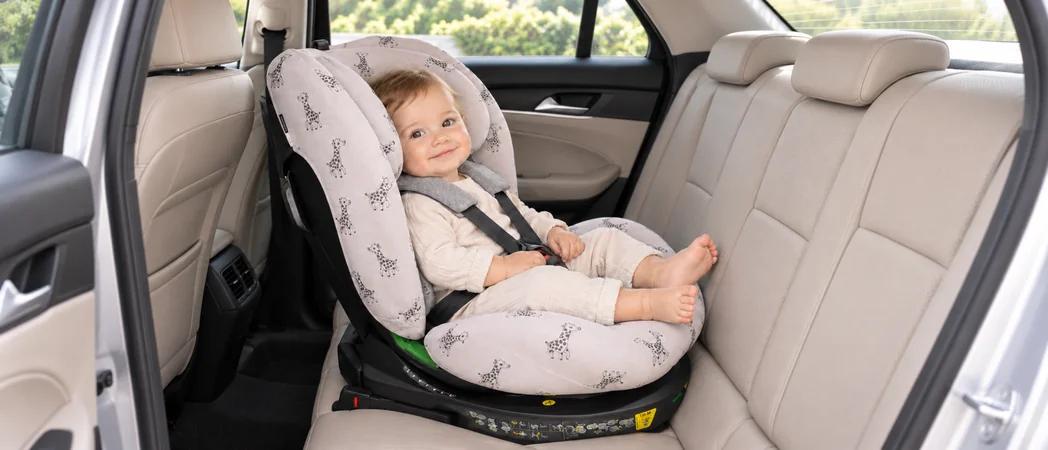
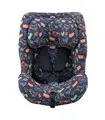
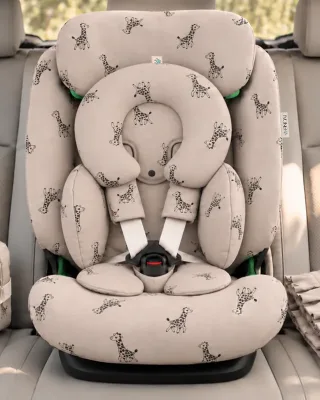
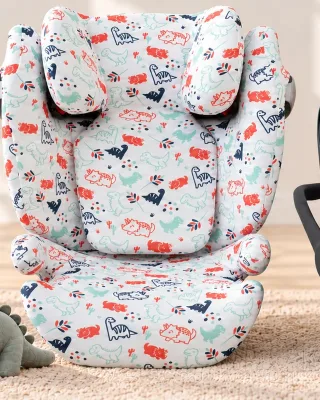
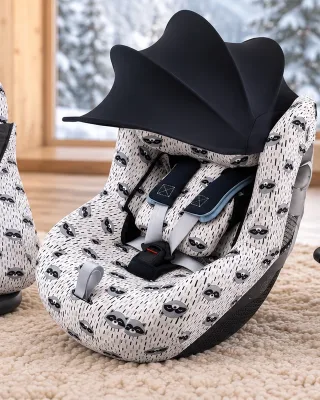
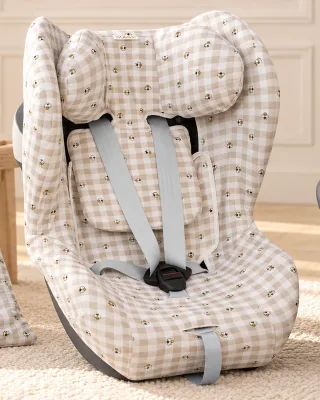
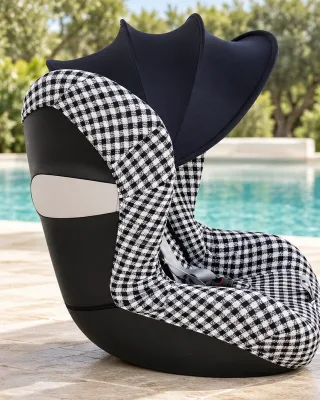
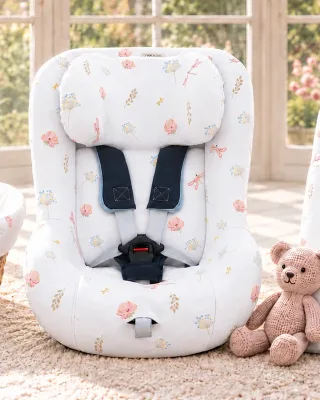
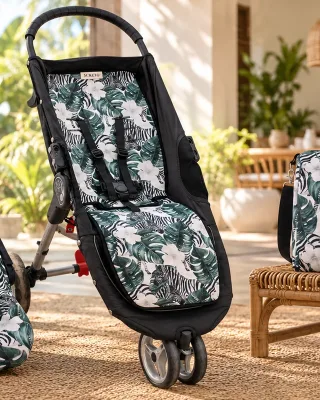
The original cover is part of the approved seat: do not remove it or replace it with another one. If you want to protect it from stains and wear, at Jyoko we make covers that go over the original cover, without replacing it, patterned model by model in our workshop in Barcelona (find the one for your seat here). They come off in a moment and go into the washing machine, without dismantling the seat. The one in the photo is from our Giraffe collection.
In short
The European study shows that a seat can be on sale and still not protect enough. We do not know which models failed, but we do know what to check: R129 label, height range, ISOFIX installation, rotation lock and general condition. Spending five minutes on it today is the best way to travel with peace of mind.
Source: European Commission, "EU testing of child car seats reveals multiple failures", 1 April 2026.